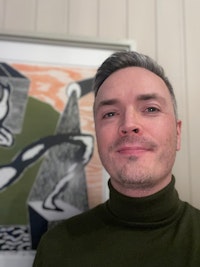
Keep up with the «Stipendiatstafett» series! Here, you'll get to know former PhD candidates from NMH, their projects, and what they work with today.
What are you up to now, Notto Thelle?

«Never academia again,» said Notto after completing his master's degree. In 2022, he earned his PhD and now leads the Makerspace at OsloMet.
When did you defend your dissertation, and in which field of study?
I defended my PhD in November 2022. The field was performance practice, with a focus on music technology – more specifically, musical co-creation with artificial intelligence.
At the time, I didn’t think – nor do I believe now – that machines will replace human creativity.
Thelle
Tell us about your project
I wanted to explore how making music with a seemingly creative computer would influence the early brainstorming phase of music creation.
When I started the project in 2018, the premise was that we were facing major shifts in artificial intelligence. I had no doubt that this would have significant consequences for how music would be made in the future, and I was particularly interested in the interaction between humans and machines.
At the time, I didn’t think – nor do I believe now – that machines will replace human creativity.
During the course of the project, I became increasingly fascinated by how creativity emerges. It is not something that arises in isolation within individuals but rather in a complex social interplay where not only humans but also the surrounding environment contribute to the creation of creativity.
We are surrounded by technology, and it plays a significant role in shaping creativity.
Why did you choose to pursue a PhD?
When I submitted my master’s degree in musicology at Blindern in 2010, I remember saying, “never academia again.” In other words, pursuing a PhD was never part of the plan. What has always been most important to me is to work in a creative field.
From 2012 to 2017, I was the director of Notam – Norwegian Centre for Technology, Art and Music. During those years, I was inspired by many innovative projects, and that was probably what motivated me to apply for a PhD when my term ended.
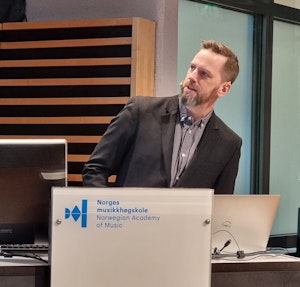
The Norwegian Academy of Music (NMH) is close enough to the creative field that the balance between academia and practice works in a way that is personally motivating for me.
I was fortunate to receive offers from both the University of Agder and NMH. The most obvious reason I chose NMH was geographical. I wanted to actively participate in an academic environment, and I wouldn’t have been able to do that as a commuting PhD candidate.
What happened after completing your doctorate?
Two months before submitting my dissertation, I came across a job posting for the position of Head of OsloMet Makerspace. It sounded incredibly exciting to me – a creative environment where art, design, and technology intersect.
I applied for the position and was fortunate enough to get it. I signed the contract on the same day I submitted my dissertation.
– Be humble enough to let yourself be shaped, but strong enough to believe that you can also leave an imprint.
to current and prospective PhD candidates
What are you doing now?
I am still the Head of Makerspace at OsloMet, and I truly enjoy it!
In short, Makerspace is a creative workshop that students can use to develop ideas, projects, and prototypes. They have access to a range of equipment, including 3D printers, laser cutters, electronics stations, textile machines, a woodworking workshop, and much more.
Here, I have personnel responsibility. Although my job is administrative – I don’t have formal research time – I am encouraged to publish. This has given me the opportunity to write articles and book chapters as a continuation of my doctoral work, as well as participate in research projects on makerspaces.
I have also received support from the Norwegian Arts Council to lead an artistic development project on musical co-creation with artificial intelligence. This eventually resulted in a chapter in the book "Når musikken tek form" (When Music Takes Shape), which was recently published by Fagbokforlaget.

What is the most important thing you’ve learned from doing a PhD?
Daring to hold on to an idea for long enough. Being humble enough to let yourself be shaped, but strong enough to believe that you can also leave an imprint.
It might sound a bit abstract, but it’s very easy to lose confidence early in the PhD journey. You meet so many talented people and think that you have nothing to contribute. But then it turns out that you actually do.
This lesson has been incredibly valuable to me, even after completing my PhD.
– Explaining your project to people who don’t have the background to understand it in depth is incredibly valuable and enlightening.
Thelle
What would you say to yourself as a first-year PhD candidate?
To be completely honest, I wouldn’t have said anything. I wouldn’t be who I am if I hadn’t done exactly what I did.
The best part of being a PhD candidate is having the opportunity to spend several years on a self-defined project. But the doubt is never far away, and that’s the worst part of being a PhD candidate. There are times when you simply feel like a complete fool.

What career advice would you give to current or prospective PhD candidates?
I would recommend being social. The best ideas often come from conversations with others, and it doesn’t have to be with someone who understands your field.
Explaining your project to people who don’t have the background to understand it in depth, because they come from other disciplines, is incredibly valuable and enlightening.