The sessions should focus on study-related activities where the student requires their accompanist. The majority of the allocated time should be spent working together with the student and accompanist. These sessions form the foundation for joint lessons with principal instrument teachers, participation in group classes, forums, masterclasses, concerts, and exams.
You and your accompanist
Here you can read the guidelines and expectations between students and accompanists at NMH.
What should accompanist sessions be used for?
Collaboration and planning
The accompanist has a teaching responsibility towards the student. The principal instrument teacher, accompanist, and student must cooperate to ensure the best possible use of accompanying resources within the given framework.
It is recommended that a meeting be held at the beginning of the semester with the student, accompanist, and principal instrument teacher to jointly plan the repertoire. Repertoire for exams and concerts should be planned well in advance. The accompanist can provide input if a particularly demanding repertoire is proposed.
Make the most of the time you have been allocated with your pianist!
on collaboration
The student's responsibilities
- The student is responsible for providing the accompanist with the necessary sheet music.
- The sheet music must be clear and preferably printed.
- If the sheet music is delivered as a PDF, the files must be appropriately labelled and well-scanned.
- Sheet music should typically be provided no later than two weeks before the first session. At times, accompanists may receive a large number of new pieces to prepare simultaneously, requiring additional preparation time.
- If repertoire is communicated too late for the scheduled performance, the accompanist can ask the student to change the repertoire or find another collaborator.
- Any activities beyond regular session appointments must be specially arranged and always planned well in advance.
Plan your repertoire in consultation with your accompanist.
tip
Organisation
- Students in KAUTKL and MAUT have 16 hours available with their accompanist.
- Students in KAMP have 12 hours.
- Students in KADI have 8 hours (0 hours in the first year of study).
Students must familiarise themselves with the total time allocation and, together with their accompanist, keep track of the hours/minutes used. Information about the number of available hours is provided at the start of the academic year.
Accompanist sessions take place throughout the semester. By agreement and approval from the accompanist, the work can be concentrated into specific periods. Hours cannot be carried over from one academic year to the next. Session scheduling is arranged directly with the accompanist.
If a student cancels on the same day or fails to attend, the session will not be rescheduled. If the accompanist or student is ill, the accompanist is not obliged to reschedule missed sessions. In prolonged absence, a substitute may be arranged in consultation with the department head.
Your principal instrument teacher and accompanist work together to support your academic journey!
your studies
Recording sessions
Students should not expect their accompanist to play for recordings unrelated to their studies (exceptions include recordings for master's applications or exchange programme applications). The accompanist has the right to assess each request case-by-case basis for potential exceptions.
Contact

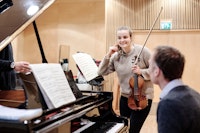
Want to learn more about accompaniment?
The accompanist is an equal musician in collaboration with singers and various instrumentalists.
Visit the accompaniment department page for more information.